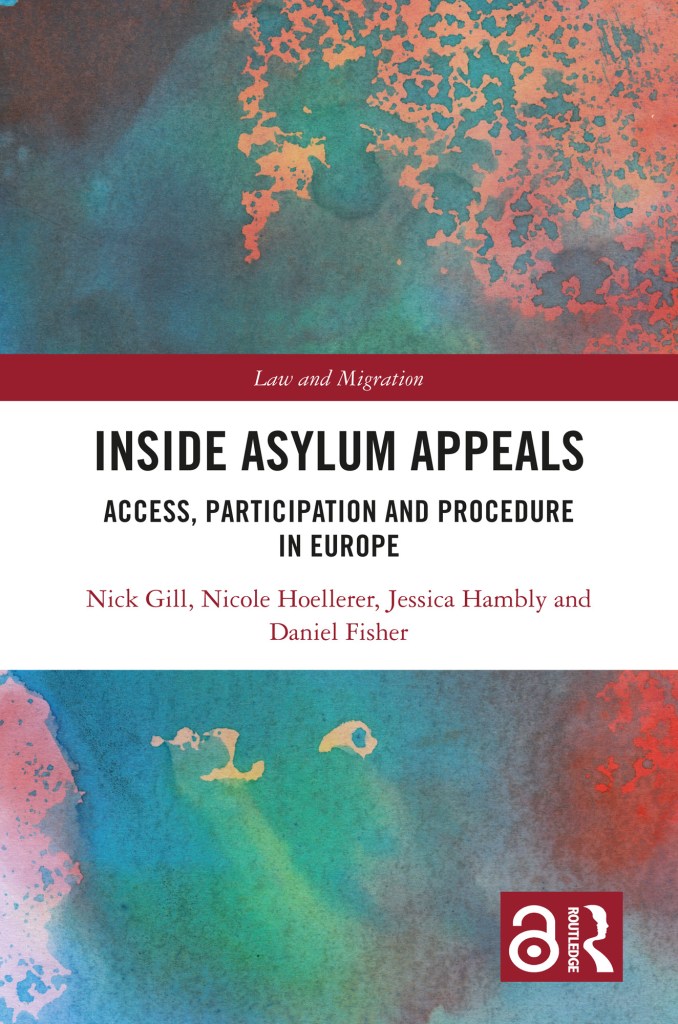
Inside Asylum Appeals: Access, Participation and Procedure in Europe
By Nick Gill, Nicole Hoellerer, Jessica Hambly, Daniel Fisher
DOI: https://doi.org/10.4324/9781003295365
eBook ISBN: 9781003295365
Paper copy ISBN: 9781032281155

OPEN ACCESS Routledge Law and Migration Series 2024 – see here
Appeals are a crucial part of Europe’s asylum system, but remain poorly understood. Building on insights and perspectives from legal geography and socio-legal studies, this book shines a light on what takes place during asylum appeals and puts forward suggestions for improving their fairness and accessibility. Drawing on hundreds of ethnographic observations of appeal hearings, as well as research interviews, the authors paint a detailed picture of the limitations of refugee protection available through asylum appeals. Refugee law can appear dependable and reliable in policy documents and legal texts. However, this work offers the unique insight that, in reality, myriad social, political, psychological, linguistic, contextual and economic factors interfere with and frequently confound the protection that refugee law promises during its concrete enactment. Drawing on evidence from Austria, Belgium, France, Germany, Greece, Italy and the United Kingdom, the book equips readers with a clear sense of the fragility of legal protection for people forced to migrate to Europe. The book will appeal to scholars of migration studies, legal studies, legal geography and the social sciences generally, as well as practitioners in asylum law throughout Europe and beyond.
Content
Part I: Setting the Scene
1. Introduction ▼
This chapter introduces the reader to asylum appeals. It sets out the key arguments and findings of the book and outlines the ethnographic approach taken. It also maps out the chapters and parts of the book to follow. (Read here)
2. What are asylum appeals? ▼
This chapter starts by offering a technical legal response to the question of what asylum appeals are. It goes on, however, to set out some of the difficulties in answering the question, drawing on socio-legal insights, and pointing out the diversity of asylum appeals. (Read here)
3. Approaching Asylum Appeals ▼
In this chapter we outline our methodology, describing our sampling, the ethical considerations of our research and our own position in relation to it. The chapter is intended to give a full and frank account of our approach, including the challenges we encountered during our fieldwork. (Read here)
Part II: Accessing Protection in Asylum Appeals
4. Before the Hearing: Waiting, Preparation and Anticipation ▼
The period before an asylum appeal can be crucial. Some appellants are able to prepare for their hearings, consolidate their health, solicit good advice and collect evidence. Others, however, are unable to carry out these tasks and find the period of waiting stressful and frustrating. Prolonged waiting can put pressure on their mental health and can also cause them to forget details of their testimony. In this chapter, we explore the uneven experiences of waiting for hearings and highlight the diversity of responses of judges when faced with appellants who found the waiting period difficult. (Read here)
5. Arriving at Court: First Impressions, Orientation and the Fragility of Trust ▼
This chapter examines the practical experiences and challenges of arriving at appeal hearings, highlighting how a series of seemingly mundane factors such as journeys to court, court signage and layout, and interactions with ushers, clerks, secretaries and security personnel can influence appellants’ propensities to engage with and trust the legal system. While judges are rightly seen as central to the experience appellants have of hearings, they are one of the last, if not the last, of the actors involved on the day of their hearing that appellants actually meet. We reflect on what some courts and staff did that raised or lowered the levels of disorientation and intimidation of appellants on arrival. (Read here)
6. Assembling Appeals: Material Perspectives on Gathering Evidence and People ▼
In this chapter we turn our attention to the practical challenge of gathering together all the components and participants necessary to stage appeal hearings. Inspired by the social sciences’ attention to the processes of assembling, we conceive of asylum appeals as feats of bodily and material assembly – of people, of information, and of expertise – which requires significant resources for its accomplishment. We examine the difficulty of gathering evidence, for example, and reflect on different countries’ approaches to the regulation of evidence. We then consider the frequency of ‘no-shows’ during appeals, meaning the non-arrival of appellants, legal representatives for the government and legal representatives for the state, which was common in our sample countries. We relate these no-shows to a series of causes including misunderstandings and political-economic pressures and express concern at the ‘thinned out’ sort of justice they can produce. Towards the end of the chapter we also reflect on the arguments for and against ‘in-person’ hearings. (Read here)
Part II Policy and Practice Compendium ▼
Short summary of our insights about the asylum appeals process with ideas for how to address the challenges, based on some of the practices we observed. (read here)
Part III: Participating in Asylum Appeals
7. The Politics of Speed: Adjudication and Participation Under Time Pressure ▼
Much of the fieldwork for this book was conducted following a marked upturn in asylum applications to European countries in 2015 and 2016, which was accompanied by moral panic about Europe’s capacity to host refugees. The political context meant that governments and policymakers were keen to reduce their expenditure on the asylum system, including refugee-status determination procedures. This chapter reviews the various consequent policy changes in our case countries that were designed to streamline asylum appeal processes. It then examines the way speediness affects hearings, arguing that key characteristics of appeals – from the interaction within them, to the way they begin and end – were impoverished by haste. (Read here)
8. Barriers to Communication in Asylum Appeals: Interpretation, Disclosure and Distractions ▼
This chapter begins by examining how variable the quality of interpretation was in hearings. It goes on to identify a series of further challenges to effective communication that we observed in hearings, including unruly children, restless members of the public, and loudness from the corridors. Countries and judges differed widely in response to these challenges, giving us plenty of scope to identify ideas for possible policy and practice improvements. (Read here)
Part III Policy and Practice Compendium ▼
Short summary of our insights about the asylum appeals process with ideas for how to address the challenges, based on some of the practices we observed. (read here)
Part IV Procedure
9. Mistakes and Incompetence ▼
This chapter reflects on how mistakes made earlier in the process shaped the work of those involved in deciding upon appeals. Some of the typical mistakes uncovered by the courts were administrative, typographical or related to translation rather than to the substance of the claim. These insights throw into question the levels of investment in linguistic, clerical and legal competence at the initial stages of refugee status decision-making which produced severe challenges later on for legal representatives, appellants and judges alike. The chapter warns of responsibility offloading by national governments onto courts and judges at the appeal stage, especially during periods of higher-than-usual asylum claims–. Mistakes are commonly thought of as unintended aberrations, but we also reflect on the function that incompetence performs in border control as a form of deterrence. (Read here)
10. Judicial Questioning During Hearings ▼
In this chapter we reflect on questioning during the hearing, which is normally conducted by the judge and legal representatives. We sketch out various types and tactics of questioning and reflect on what can help to make questioning effective in asylum appeals. We then examine instances of problematic assumptions that characterised the verbalised reasoning of some of the judges we observed. When judges expressed scepticism about appellants’ accounts, they sometimes referenced European, white, mainstream Christian and heteronormative standards of what was ‘normal’ and hence what could be considered unusual or improbable. By identifying these instances, the chapter draws attention to the importance of reflecting critically on the yardsticks that judges and others employ to define normalcy, deviance and likelihood when making credibility assessments. (Read here)
11. Judicial Styles ▼
This chapter explores what we call the ‘style’ of the judges we observed, meaning their observable manner, including their apparent emotionality, their transparency and tactics, the nature of their interactions, their reactions to events in the hearing as it proceeds, and the extent of their attempts to direct proceedings. We rely on judicial demeanour, including the speech, voice, body language and facial expressions of judges, to help us detect different styles. On this basis we outline four ‘types’ of stylistic approach to conducting hearings, which we characterise as ‘inside-out’, ‘schoolmaster- and schoolmistress-like’, ‘detached’ and ‘simmering’, each entailing different combinations of emotionality and orchestration. Taken together, they illustrate the variability of judicial approaches to asylum appeals. (Read here)
Part IV Policy and Practice Compendium ▼
Short summary of our insights about the asylum appeals process with ideas for how to address the challenges, based on some of the practices we observed. (read here).
12. Conclusion ▼
This chapter sets out the main findings of the book focusing specifically on the fragility of legal protection for asylum seekers in Europe. We also discuss the policy and practical implications of our work and provide some broader reflections on the organisational and power structures of the asylum system. (Read here)
Endorsements
“The authors of this impressively rich social-legal book dived deep into the functioning of the appeal hearings in the EU by observing them and interviewing both asylum seekers and decision makers. The book has both societal and scientific importance. Over a quarter of the initial decisions that were appealed in the EU were found to be deficient when they were re-examined in the appeal stage. However how the appeal-stage works in practice was until now under researched. By doing bottom up ethnographic and comparative research the authors fill this gap and shed light on amongst others, the routines and cultures, the power asymmetries, the plural ways of interpreting and the lived experiences. The book shows that although in theory a firm legal appeal system exists, in practice the legal protection of refugees in the EU is precarious and fragile. The book is indispensable food for thought for asylum practitioners, lawyers and judges and an invaluable contribution to the theory of the functioning of legal professionals.”
Professor Ashley Terlouw, Radboud University, The Netherlands
“Asylum seeking continues to be a dominant political issue throughout Europe, where the apparent consistency of approach implied by the development of the Common European Asylum System masks wide variations in national responses, and conceals the disjointed, inefficient, and often inhumane operations of those national systems themselves. This important book directly examines these incoherent, on-the-ground realities through extensive field observations of asylum procedures in seven European countries, and presents practical recommendations for their improvement.”
Professor Emeritus Anthony Good, University of Edinburgh, UK
 ASYFAIR